1 - Men's wallet formats: which model to choose?
Men's small leather goods come in several distinct formats, each answering different uses and habits. Understanding these formats is the first step toward the right choice.
The most widespread format for daily urban use. Thin, it slides easily into the front pocket of a pair of pants without creating awkward bulk. Depending on the model, it holds 6 to 10 card slots, a bill compartment, and a zipped coin pocket. Dimensions stay compact: from 3.9 x 4.7 inches (10 x 12 cm) to 4.3 x 5.9 inches (11 x 15 cm). At Le Tanneur, this format is available in the Lucien line, in grained leather, grain T leather, and oiled leather.
The vertical bifold wallet
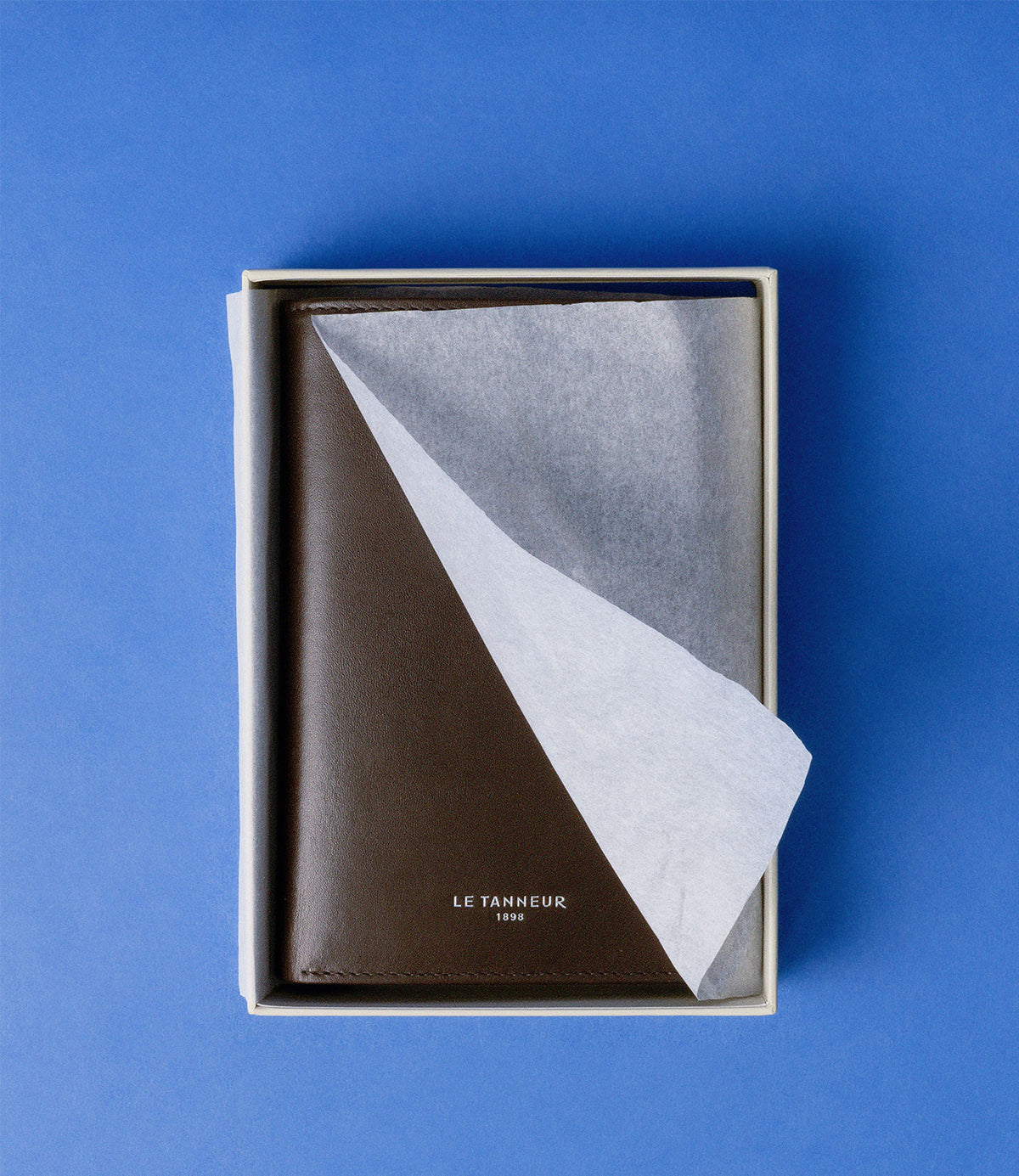
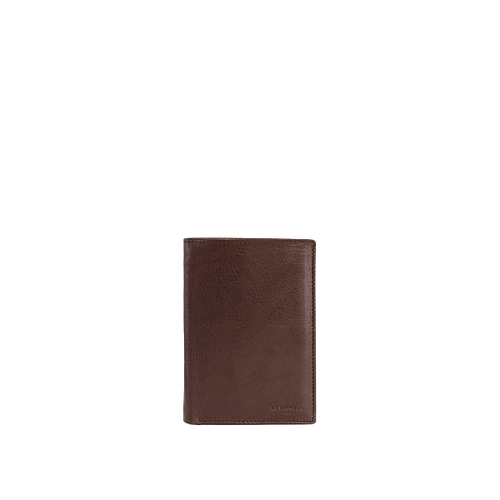
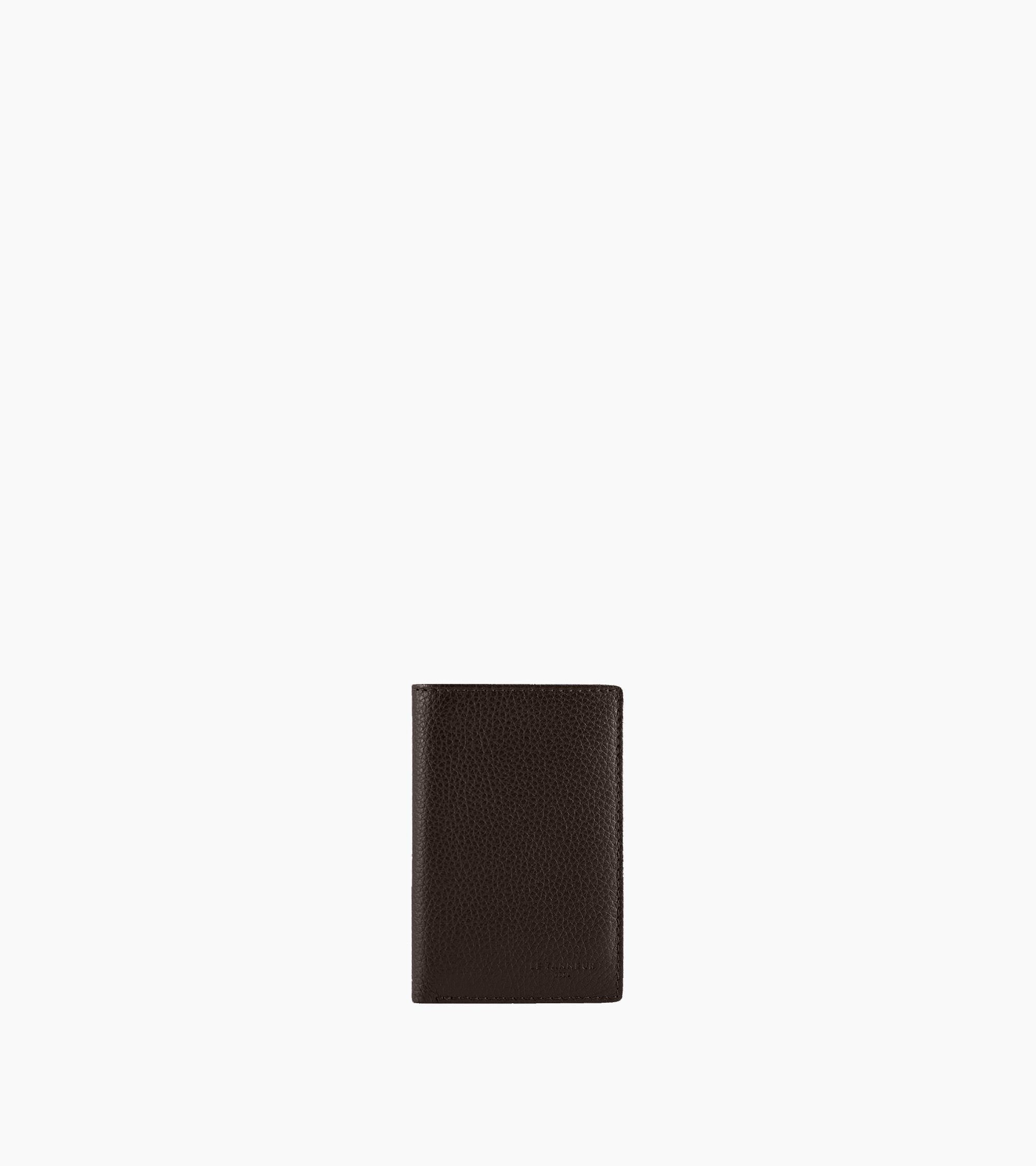
More structured, the vertical bifold wallet offers greater capacity: up to 21 card slots on certain models, two bill compartments, a zipped coin pocket, and dedicated spaces for identification. It measures between 3.9 x 5.3 inches (10 x 13.5 cm) and 4.1 x 6.1 inches (10.5 x 15.5 cm). This is the format favored by those who manage multiple credit cards, professional cards, and documents daily. Our Lucien line offers it in grained, grain T, oiled, and corked leather, and our Martin line decline it in smooth leather.
The horizontal bifold wallet
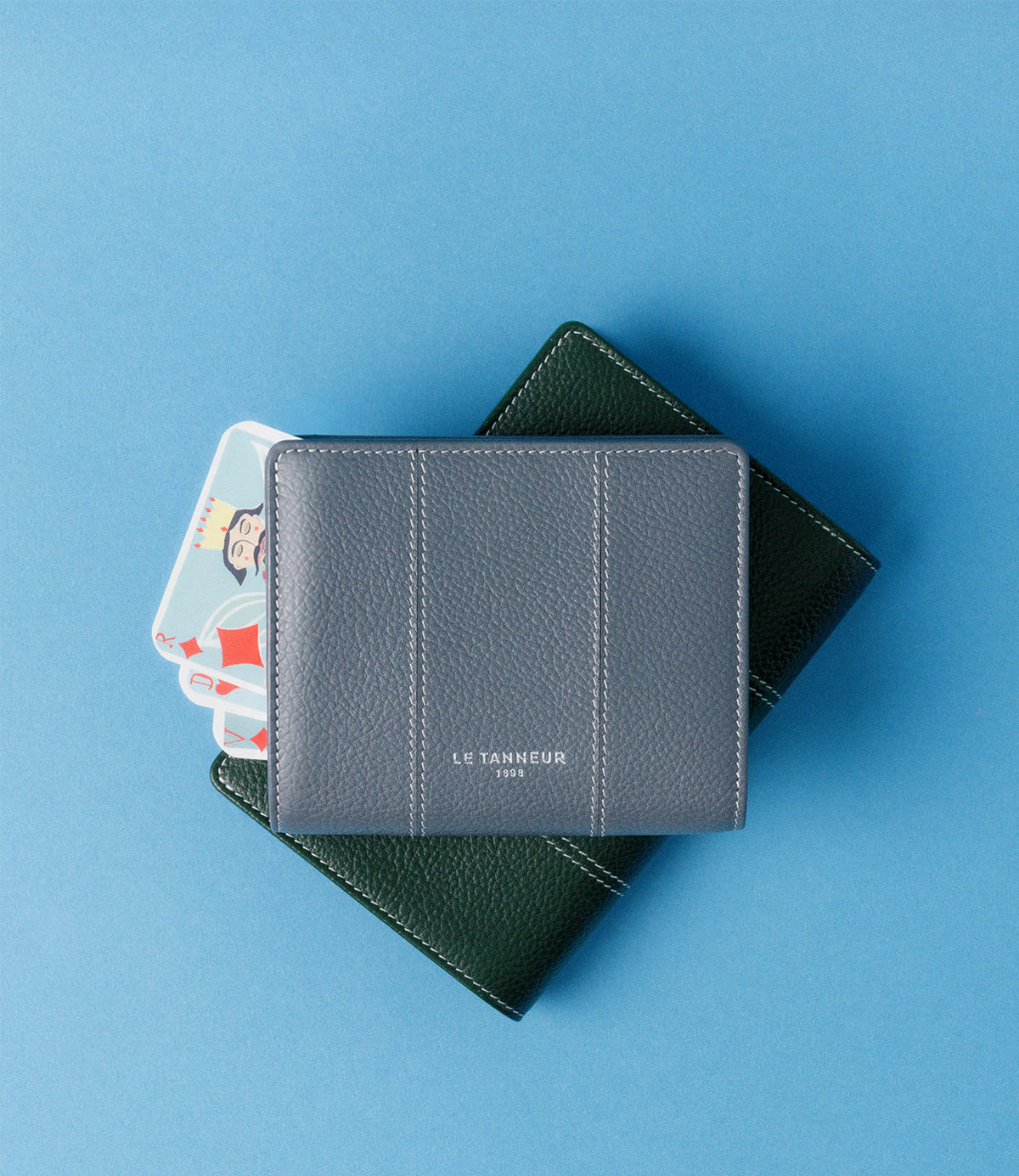
Less common in the US market, the horizontal format offers a different grip. It opens like a notebook, with lateral access to the compartments. It typically holds 8 to 10 card slots, two bill compartments, and a coin pocket, with dimensions ranging from 4.7 x 3.7 inches (12 x 9.5 cm) to 4.7 x 3.9 inches (12 x 10 cm). Our Lucien line in grained leather and our Charles line in bicolor grained leather (Black/Blue) offer this format.
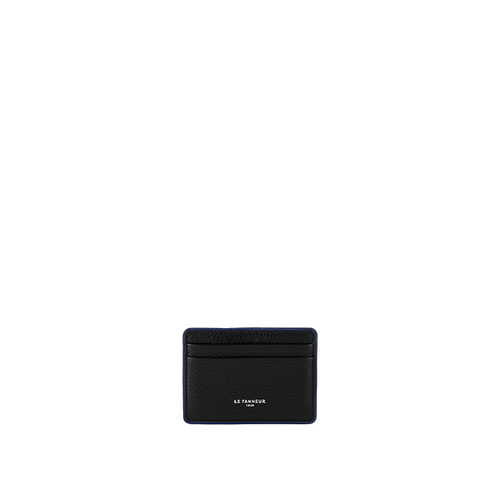
For a strictly minimalist use, the cardholder is the most pared-down answer. Several formats are available: simple 4-slot (3.9 x 3 inches / 10 x 7.5 cm), vertical 8-slot with bill pocket (3.1 x 4.3 inches / 8 x 11 cm), horizontal 2-fold 6-slot (4.1 x 2.8 inches / 10.5 x 7 cm), or zipped to secure cards and a few coins. Some models include MagSafe technology, allowing magnetic attachment directly on compatible iPhones. Our Lucien line covers the full range, in grained and grain T leather. The Martin line offers them in smooth leather, including a color-block version.
Distinct from the wallet, the coin purse is dedicated to coins and small bills. It is carried alone or alongside a cardholder. Formats range from the compact zipped coin purse (4.1 x 2.8 inches / 10.5 x 7 cm) to the box-shaped coin purse with bill pocket (3.9 x 3.5 inches / 10 x 9 cm), including the flap cup model (3.1 x 3 inches / 8 x 7.5 cm). These formats are available in our Lucien line in grained, grain T, and oiled leather.
2 - How much capacity should your men's wallet have?
One of the most common questions when buying a wallet, and one of the worst-posed. A wallet's capacity is not measured by the maximum number of compartments it offers but by the number of cards and documents you actually use daily.
Before choosing a format, list what you really carry: credit card, driver's license, insurance card, loyalty cards, transit passes, cash. Most men do not use more than six cards daily. A slim vertical wallet with 6 or 8 slots is often more than enough.
The pitfall of the wallet that bulges
An overloaded wallet loses its shape, tires the leather, and ends up permanently deformed. The rule is simple: a well-cared-for full-grain leather wallet keeps its shape if it is used at 70 percent of its maximum capacity. Beyond that, the leather works too hard and the stitches wear prematurely.
Slim or traditional: how to decide
A slim vertical wallet comfortably holds 6 to 8 cards and a few folded bills, for a thickness under 0.6 inches (1.5 cm) in normal use. This is the format for those who have adopted contactless payment and limit cash use. A vertical bifold wallet offers 8 to 21 slots depending on the model, with dedicated spaces for bills, coins, and ID. It fits those whose professional lives require more complete organization.
Cash use is declining in the US, but it has not disappeared. If you still pay regularly in cash, a wallet with a zipped coin compartment or a dedicated gusset remains essential. Our Lucien line models offer up to two gussets and a zipped coin pocket on the most complete formats. If your cash use is limited to occasional coins, a standalone coin purse paired with a cardholder is a more elegant and functional alternative.
US bills: a specific consideration
US dollar bills measure 6.14 inches long (15.6 cm) — longer than most European banknotes. A wallet designed for the European market may be too short to hold US bills flat. All Le Tanneur wallets are built with bill compartments calibrated to accommodate US bills without folding or creasing. For those who travel between regions regularly, a wallet designed to this specification handles both currencies without issue.
3 - Men's leather: the specifics
The fundamentals of leather — full-grain, vegetable tanning, LWG certification — are covered in our Small Leather Goods Guide. Here, we focus on what distinguishes the leathers used in men's small leather goods specifically.
Grained, smooth, grain T, oiled, corked: the surface finishes
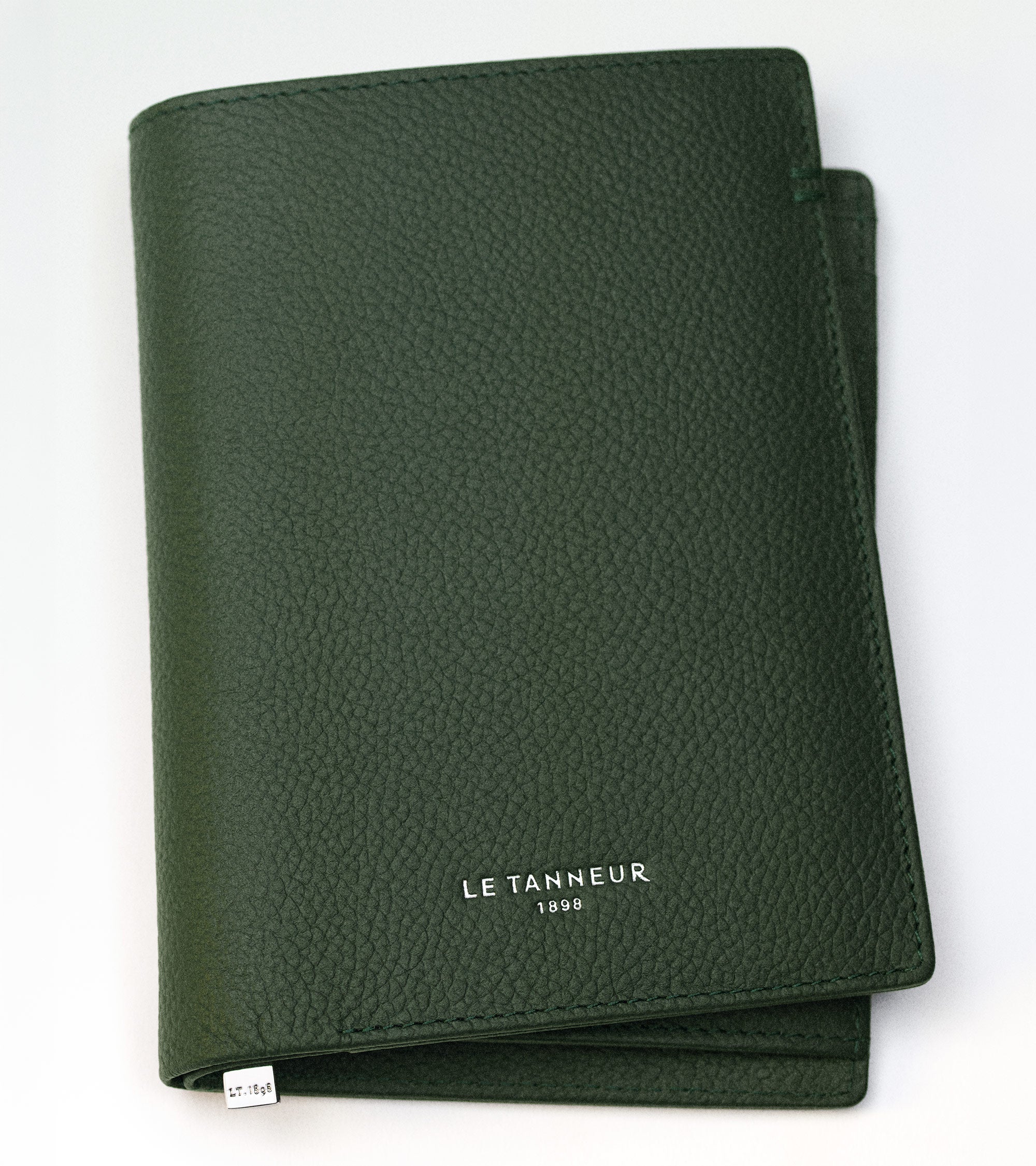
Beyond the intrinsic quality of the leather, the surface finish influences how the piece behaves in use. Grained leather, whose grain is obtained by hot pressing, is slightly less sensitive to scratches and daily marks. It is the most versatile leather for use in a pocket. Smooth leather, with its unmodified natural surface, develops a more visible and more pronounced patina over time. It is the choice of those who appreciate living leather. The grain T leather is Le Tanneur's signature leather: an infinity of T letters micro-embossed in tone-on-tone on the leather's surface, from an exclusive plate developed by the house's design studio. Oiled leather, semi-vegetable tanned and full-grain, stands out for its glossy touch and characteristic softness. Robust and warm, it acquires a deep, singular patina over time, reflecting each use. Corked leather, finally, combines firmness and resistance thanks to its cross-grain embossing — a resolutely business look.
Patina: a feature, not a defect
A full-grain leather that patinas is not a leather that ages badly. It is a living leather that tells a story about the one who carries it. The nuances that appear over time, the zones of friction that darken slightly, the deepening reflections: these are the markers of a quality leather used and cared for. A bonded or low-quality leather does not patina; it degrades. One specific point for men's wallets: the slight dark marks that cards sometimes leave on the exterior after a few months are often perceived as a defect. They are in fact part of the natural evolution of the material. On a full-grain leather, these marks become part of the patina. On a low-quality leather, they lift the finish and reveal the material underneath. The ability to carry these traces well is itself a quality criterion.
4 - Construction specifics for men's wallets
The construction standards for Le Tanneur small leather goods — saddle stitch, hand-finished edges, calibrated card slots — are detailed in our Small Leather Goods Guide. Three construction points are especially critical for men's wallets, given how they are used.
Where two pieces of leather meet, especially at corners and gussets, the joint must be thin and regular. Careful skiving — the thinning of leather at assembly points — ensures a homogeneous thickness without unsightly bulk. On a wallet carried in a front pocket for years, a thick, irregular joint will show as a worn spot long before the rest of the piece.
Resistance to pocket friction
A men's wallet is subject to specific wear: carried in the back or front pocket, it endures repeated friction against pants fabric. This wears corners and edges progressively. A corked or oiled full-grain leather handles this constraint better than a lighter leather. Hand-painted edges, polished and resistant, are the first indicator that the piece is built for pocket life.
Zippers, snap buttons, rings: these components see intensive wear in a daily-use wallet. Quality metal, properly set and corrosion-resistant, does not loosen and does not tarnish prematurely. It is a criterion often overlooked at the point of purchase, and yet one of the first failure points on low-quality pieces.
5 - RFID, MagSafe, and features: what to know before buying
RFID protection: standard, not optional
RFID blocking is built into the lining of our wallet and cardholder lines. The technology blocks the radio waves emitted by contactless readers, preventing fraudulent reading of contactless card data. In the US market, where contactless payment is widespread and where high-density transit environments make skimming more likely, RFID protection has moved from a nice-to-have to a standard expectation.
The MagSafe cardholder of the Lucien line allows magnetic attachment on compatible iPhones (from the iPhone 12 series and all MagSafe-certified cases). The format answers a contemporary use: keeping essential cards directly on the phone, with no separate wallet to carry. A single slot holds two cards. For buyers who want to carry even less, this is the most pared-down option available.
A functional wallet is one where you find what you are looking for in a single motion. Card slot layout, slot depth, ease of extraction: these ergonomic details do not show in a product photo but reveal themselves immediately in hand. A slot that is too tight damages cards and tires the leather. A slot that is too loose lets cards slip and fall. The right calibration holds the cards firmly without compressing them.
6 - Men's wallet: which format for which use
Choosing a wallet is above all choosing an object adapted to your way of living. The same format does not fit every situation. Here are concrete references to orient your choice.
The slim vertical wallet is the format best adapted to daily city use. Thin, light, it sits in the front pocket without creating bulk and centralizes the essential: six to eight cards, a few bills, a coin pocket. If you have adopted contactless payment and limit your cash use, a cardholder from the Lucien line in grained, oiled, corked, or grain T leather is more than enough. For those who want to keep a few bills with their cards, slim models with an integrated bill pocket offer the best balance between capacity and footprint.
A vertical bifold wallet is the reference format for demanding professional use. It offers enough capacity to manage multiple credit cards, professional cards, identification, and cash without sacrificing elegance. Our Lucien line models in corked leather, with their assertive business look, suit this use particularly well. The Martin line in smooth leather also offers bifold formats adapted to a professional environment.
On the move, the priority is security and centralization of documents. A bifold wallet with ID window, zipped coin pocket, and RFID protection is the ideal format. It brings together cards, bills in several currencies, and travel documents in a single object. Our Lucien line models in oiled leather, robust and resistant to heavy use, are particularly suited to frequent travelers. Their semi-vegetable-tanned full-grain leather acquires a deep patina over time that tells each trip.
The cardholder is the answer to a need for pared-down carry. Four to eight card slots, a few folded bills: the essentials, nothing more. The Lucien MagSafe cardholder pushes minimalism further still, with direct attachment to the iPhone. For those who want to keep a few coins without carrying a full wallet, a standalone coin purse from the Lucien line paired with a cardholder is the most elegant solution.
A note on category and gender
Some of the pieces listed above sit in the men's category by convention more than by design. The Charles bifold and several Lucien pieces work beautifully regardless of gender, and we see them regularly chosen by women who appreciate the sober lines and practical construction. If a piece in another category speaks to you, it is yours to carry.
7 - How to spot a well-made men's wallet
A quality wallet is recognized by specific details, observable by eye or by touch. Here is a concrete checklist to evaluate a piece before buying.
The edges are the visible sides of the leather across the entire piece. On a well-made wallet, they are hand-painted and polished, smooth to the touch and regular across their full length. Edges painted roughly, irregularly, or left raw are the sign of factory-grade construction without finishing standards. This is one of the most reliable indicators of quality and one of the first places to look.
A quality stitch is regular, taut, with no skipped stitches or dangling threads. The saddle stitch, done by hand with two needles and a waxed thread, is the standard of fine leather goods. It shows a perfect regularity and no visible points of tension. A machine stitch is not necessarily a defect, but it must remain regular and solidly anchored in the leather.
The junction zones between two pieces of leather, especially at corners and gussets, must be thin and regular. Careful skiving, done before assembly, guarantees a homogeneous thickness without unsightly bulk. A thick, irregular joint reveals insufficient or absent skiving.
The interior of a wallet is as revealing as its exterior. A quality leather or textile lining, well-calibrated card slots, properly finished interior edges: these are details that distinguish a piece built to last. A sloppy interior, with raw fabric edges or misaligned slots, reveals insufficient attention to the whole.
Zippers, snap buttons, rings: these components must be solidly set, corrosion-resistant, and fluid in use. A zipper that catches, a snap that loosens, or a ring that tarnishes quickly are warning signs about the overall quality of the piece.
A quality full-grain leather has a clean, slightly soft feel, with a slight natural resistance. It does not stick to fingers, does not smell like plastic, and does not show an overly uniform surface. Bonded or low-quality leather is often recognized by a too-smooth, too-rigid, or slightly sticky feel.
On a well-made piece, all finishes are consistent with each other: the edge color matches the leather, the stitching thread is matched, the metal hardware has a uniform finish. An inconsistency in finishes, even a minor one, reveals a lack of quality control at the end of production.
A full-grain leather wallet has a clean, perceptible weight in hand. Too light, it may signal a thin or bonded leather. Too heavy when empty, it risks becoming uncomfortable in daily use. The right balance is a piece that has presence in hand without weighing down the pocket.
8 - Caring for your men's wallet
The general care routine — cleaning, nourishing, protection, storage — is covered in our Small Leather Goods Guide. Here, we focus on what is specific to men's wallet wear.
Men's wallet wear patterns
A men's wallet faces specific wear constraints. Carried in a back or front pocket, it endures repeated friction against pants fabric, which progressively wears corners and edges. Credit cards, extracted several times a day, carve marks into slots over time. Folded bills exert constant pressure on the leather and the stitches. All of these constraints should be accounted for when adapting care.
A leather that starts to crack lacks nourishing. Edges that begin to flake signal insufficient surface finishing or a low-quality leather. A stitch that gives way on a single point can be picked up by a leatherworker before the problem spreads. A full-grain leather wallet that is well-constructed can be repaired — one of the major advantages of investing in a quality piece. The buy-it-for-life approach starts here: a piece that can be repaired, cared for, and kept for 15 years.